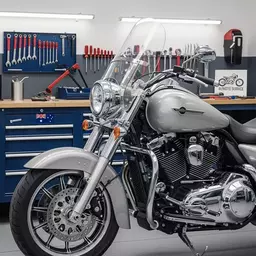
A motorcycle that will not start does not automatically need engine work. First identify whether the symptom belongs to the key and lock system, immobiliser, starting system, or a broader electrical or mechanical fault. That distinction can change who should inspect the bike first.
For a Melbourne key or access issue, readers can start with All Melbourne Locksmith. If the key turns normally and the bike shows clear mechanical or electrical symptoms, a mechanic may be the better first call.
A no-start complaint can describe several very different faults. "It will not start" is not enough information for a workshop, locksmith, dealer, or roadside provider to narrow the job.
Before booking anyone, observe what happens in order.
This points first toward a physical access or lock problem. The key may be worn, bent, damaged, or obstructed. The ignition barrel or steering lock may also be binding.
Do not add force because the motorcycle is otherwise mechanically healthy. A key that is already twisted or cracked can break inside the barrel.
This symptom may involve the battery, battery connections, a main fuse, an ignition switch circuit, or another electrical fault. It is not enough by itself to identify the cause.
Record whether any lights, clock, security indicator, or accessories respond. That information helps a technician decide where diagnosis should begin.
Modern motorcycles may require the key, transponder, or proximity fob to authenticate before the motorcycle can start.
Indian Motorcycle's April 2026 keyless ignition guidance explains that its key fobs authenticate the motorcycle for startup. On equipped models, the multifunction fob can also arm or disarm an integrated alarm and immobiliser.
That does not mean every motorcycle uses the same system. It does mean a security warning should not be treated as an ordinary engine fault without checking the model's key and immobiliser behaviour.
This shifts attention toward fuel, spark, ignition, sensor, or control-system diagnosis. A mechanic may need to test the starting and engine-management systems.
However, do not ignore an immobiliser symbol or a problem that appears only with one key. Some security systems can allow partial electrical activity while still preventing normal starting.
That comparison is valuable. It can point away from a general engine problem and toward the non-working key, transponder, remote, or key registration.
Keep both keys available. Do not throw away a damaged or unreliable key before the fault has been identified.
A rider can collect useful information without dismantling the motorcycle. The goal is not to complete a workshop diagnosis at home. It is to rule out simple conditions and describe the symptom accurately.
Start with the controls that affect normal starting.
Check that:
the engine stop switch is in the run position
the motorcycle is in neutral where appropriate
the side stand is positioned as required by the model
the clutch is operated if the starting procedure requires it
the correct key or fob is being used
the fob battery warning is not showing, if the model has one
the instrument panel is displaying any security or fault symbol
the battery is not obviously flat from long storage
recent electrical work has not left a connector or battery terminal visibly loose
Use the owner's manual for the motorcycle's exact starting sequence. Do not assume every brand handles sidestand interlocks, clutch switches, keyless systems, and immobilisers the same way.
If you want to understand what is reasonable for a rider to inspect before professional work, Race Bike Services' DIY motorcycle servicing resources can help define the boundary between routine checks and jobs that need proper diagnostic equipment.
A physical ignition problem tends to feel different from a fuel, starter, or engine fault.
Signs that deserve key or lock attention include:
the key does not insert fully
the key has become visibly bent
the key turns only after unusual pressure or movement
the ignition barrel feels rough or jams
the key cannot be removed normally
the steering lock will not engage or release as designed
part of a key has broken inside a lock
the spare key behaves differently from the main key
These symptoms are mechanical, but they are mechanical problems inside the lock and access system. That is a different specialisation from engine repair.
A mechanic may still identify the issue during diagnosis, but forcing the ignition can make the eventual repair harder.
An immobiliser is an anti-theft system. On many equipped motorcycles, it checks whether the authorised key, transponder, or fob is present before allowing normal starting.
Common clues include:
a security or key symbol that behaves differently from normal
a motorcycle that starts with the spare key but not the primary key
a keyless motorcycle that does not recognise the fob
a no-start that began after a key was damaged
a no-start after a replacement key or ignition component was introduced
normal dash activity with a persistent security warning
Do not diagnose an immobiliser from one warning light alone. The meaning of the light is model-specific.
Check the owner's manual before deciding what the symbol means. Note its colour, whether it flashes or stays solid, and what happens when you try the spare key.
If the problem is clearly related to key authentication, key programming, the ignition barrel, or a steering lock, a motorcycle locksmith or authorised dealer may be the right specialist. If the key is recognised but the motorcycle still has starting, charging, fuel, or ignition faults, a mechanic is more likely to be the correct provider.
A resistant key is a warning, not an invitation to use more leverage.
Avoid:
gripping the key with pliers
striking the key or ignition
forcing the steering lock
drilling the barrel
inserting improvised tools into the lock
spraying random chemicals into the ignition
bypassing immobiliser wiring
joining wires to defeat a security system
fitting a higher-rated fuse after a fuse fails
These actions can turn one fault into several. They can also erase useful diagnostic clues.
If the key is stuck, cracked, or partly broken, leave it in the condition you found it. Tell the specialist exactly what happened before the problem appeared.
The same principle applies to immobilisers. Do not bypass a security system to prove that the engine can run. The correct task is to determine whether the system is recognising the authorised key and whether the rest of the starting system is functioning normally.
A mechanic is generally the better starting point when symptoms sit beyond the key and lock system.
Examples include:
the key turns normally, but the starter only clicks
the starter cranks slowly with a known battery problem
the engine cranks but does not fire and no key warning is present
the motorcycle starts and stalls with fuel or ignition symptoms
the charging system is not maintaining the battery
the starter motor or starter relay is suspected
the side stand, clutch, or neutral interlock appears faulty
a wiring, connector, sensor, ECU, or ignition-coil fault is suspected
the bike runs but has braking, steering, suspension, fuel, or engine issues
If you are comparing workshops, use the site's guide to choosing your motorcycle mechanic. Prefer a repairer with experience on your make, model, and the system involved.
A workshop with the right diagnostic equipment may be able to separate battery, starter, sensor, ignition, fuel, and ECU faults faster than a general repairer working by substitution.
A locksmith or dealer may be the more direct first call when access and authorisation are the central problem.
That includes situations where:
all motorcycle keys are lost
the only key is broken
the key will not turn the ignition
a broken key is stuck in the barrel
the steering lock is jammed
a replacement key needs cutting
a transponder key needs programming
the motorcycle accepts one key but rejects another
a keyless fob is damaged or not being recognised
the ignition barrel itself is worn or damaged
Provider capability varies by motorcycle brand and year. Some immobiliser jobs require dealer-specific procedures or equipment. A competent specialist should ask for the make, model, year, key type, and exact symptom before accepting the job.
Proof of ownership should also be expected for key cutting or programming work. Have registration, identification, or other ownership records available.
The quality of your booking information affects the first diagnostic decision.
Do not say only, "The bike won't start."
Instead, prepare a short symptom record.
Include:
Make, model, and year.
Model year can matter because key and immobiliser systems change within the same motorcycle family.
What happens when you turn the key or press start.
State whether the dash lights, the starter clicks, the engine cranks, or nothing happens.
Any warning symbol.
Describe the exact icon, colour, and flashing pattern if you can.
Whether the spare key works.
This is one of the most useful comparisons for a suspected key fault.
What changed immediately before the problem.
Mention a flat battery, key damage, a fall, electrical work, storage, rain exposure, an attempted theft, or a replacement ignition part.
What you already tried.
Be specific. Tell the provider if you charged the battery, replaced a fob battery, tried the spare key, or moved the bike out of steering lock.
Where the motorcycle is.
A mobile specialist, roadside service, workshop, or transporter needs to know whether the bike can be moved safely.
This information can also make workshop comparisons more meaningful. A low estimate given without understanding the fault is not the same as a diagnosis-based estimate.
Race Bike Services' motorcycle repair costs in Australia provides broader context for comparing repair pricing and avoiding assumptions based on one headline figure.
The word "ignition" causes unnecessary confusion because it can describe two different areas.
The ignition lock or ignition switch is the component the key physically operates on a keyed motorcycle.
The engine ignition system refers to the components that create and control the spark needed for combustion. Depending on the motorcycle, that can involve coils, plugs, sensors, wiring, the ECU, and related control circuits.
A key that jams in the barrel is not the same symptom as an engine that has no spark.
Likewise, a motorcycle with a recognised key can still have an ignition-system fault that needs a mechanic.
Use precise language when booking:
"The key will not turn in the ignition barrel."
"The key turns and the dash comes on, but the engine does not crank."
"The starter cranks, but the engine does not fire."
"The immobiliser light remains on."
"The spare key starts the bike, but the main key does not."
Those descriptions are far more useful than saying the "ignition is broken."
Basic observation is useful. Unplanned dismantling is not.
A rider can reasonably check controls, warning lights, obvious battery condition, the spare key, and the documented starting procedure. Beyond that point, the tools and knowledge required can change quickly.
Stop DIY diagnosis if:
you need to defeat a safety interlock
you are considering bypassing the immobiliser
the wiring diagram is unclear
the ignition barrel must be dismantled
a key must be programmed
a security module or ECU must be paired
the same fuse fails again
wiring is burnt, melted, or damaged
the bike has intermittent power loss
the steering lock does not operate normally
Do not keep replacing parts because an online symptom list mentions them. A battery, starter relay, key, ignition switch, immobiliser antenna, ECU, or sensor can produce overlapping symptoms.
Diagnosis should narrow the fault before parts are ordered.
Getting the motorcycle started does not automatically prove it is ready to ride.
If the fault involved intermittent electrical power, damaged wiring, a loose ignition assembly, steering-lock interference, or an attempted theft, the bike may need inspection before returning to traffic.
Victoria Police's June 2026 motorcycle safety guidance notes that a Roadworthy Certificate is not by itself a guarantee that a motorcycle is safe. Riders should still check that the motorcycle has no dangerous or illegal damage or modifications.
That principle matters after a no-start or access incident. If the motorcycle has physical damage or unstable electrical behaviour, arrange suitable transport or recovery rather than treating one successful start as proof of reliability.
Once you have separated the likely category, compare providers on the problem you actually have.
For a mechanic, ask:
Do you work on this make and model?
Do you diagnose starting and electrical faults?
What diagnostic charge applies?
Will you call before additional work?
Can the bike be stored securely if it cannot be collected immediately?
For a key or immobiliser specialist, ask:
Do you work on this motorcycle model and year?
Can you cut or program this key type?
Do you repair the ignition or steering lock?
What proof of ownership is required?
Is the work mobile, workshop-based, or dealer-dependent?
If the bike clearly needs workshop attention, Race Bike Services also has a guide for riders looking to find certified motorcycle repair shops.
The point is not to avoid mechanics. It is to avoid booking engine or general workshop diagnosis for a fault that is plainly in the key and lock system, and to avoid booking a locksmith for a fuel, charging, starter, brake, or engine problem.
Before you make the call, collect the following:
motorcycle make
exact model
model year
registration details
location of the motorcycle
whether it can be moved
whether the key enters and turns normally
whether a spare key works
whether the motorcycle is keyed or keyless
any immobiliser or security warning
what the dash does
whether the starter clicks or cranks
recent battery or electrical work
evidence of theft or physical ignition damage
the last time the motorcycle started normally
the checks you have already completed
Keep the list short enough to read over the phone.
A good provider should be able to tell you whether the symptom fits their scope, what they need to inspect, and whether the bike should come to a workshop.
Before booking a workshop, separate key access, ignition-lock behaviour, immobiliser recognition, and general no-start symptoms.
If the key works normally and the fault points toward the starter, fuel, charging, engine ignition, sensors, or wiring, book a mechanic with relevant model experience. If the key, lock, remote, or immobiliser is the obvious problem, contact the appropriate key specialist or dealer first.
Use the site's guide to choosing your motorcycle mechanic wisely once you know what repair you are comparing. A clearer fault description reduces guesswork before the bike reaches the workshop.